Pinterest · Case study 01
Pinterest's Collaboration Ecosystem
Building the foundations for meaningful connection, sharing, and retention
Role
Staff Product Designer, Growth / Social Experiences
Focus
Product Strategy · Design Systems · Social · Platform
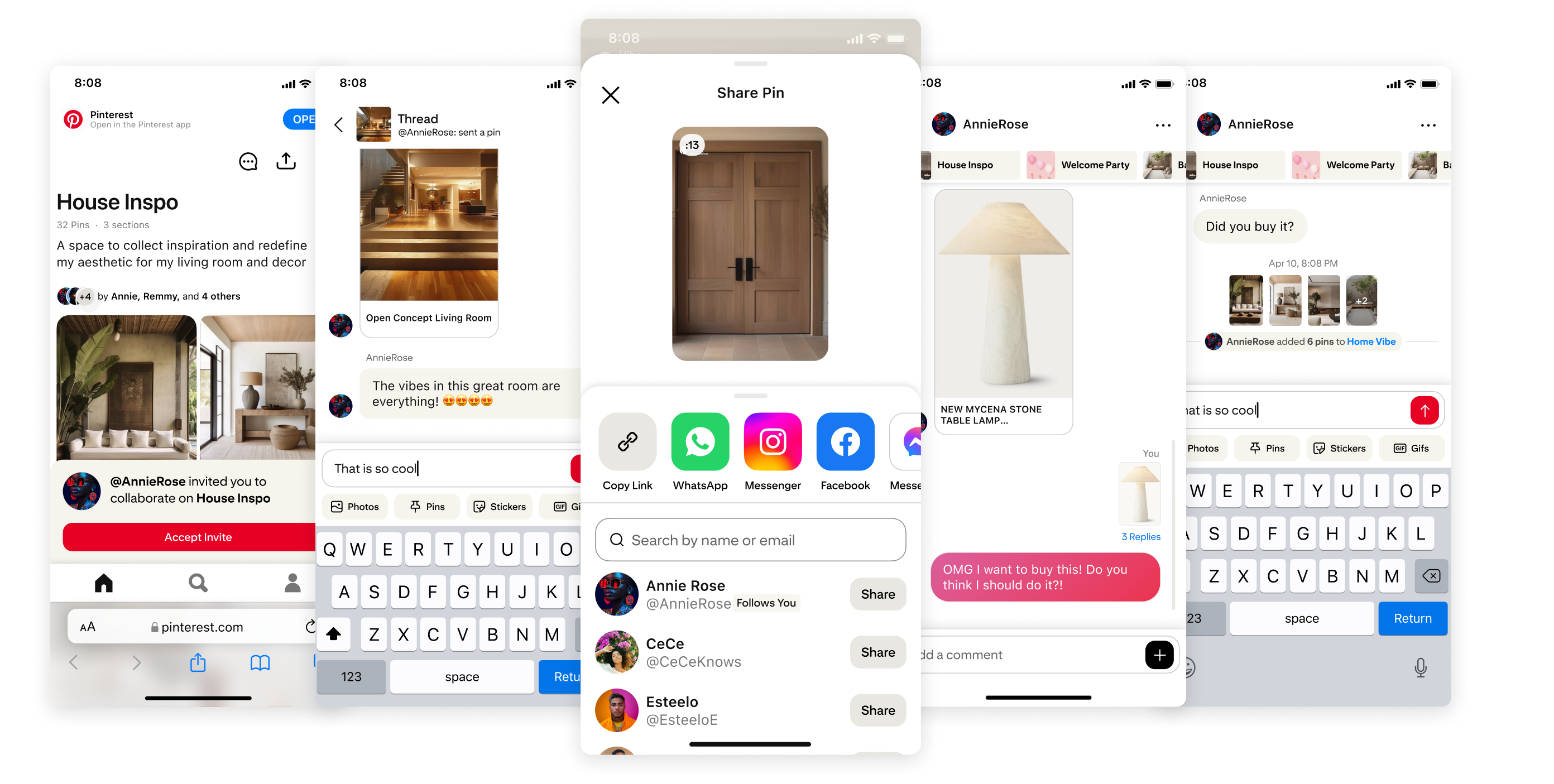
Pinterest is personal first, but the path from inspiration to action is rarely solo. Pinners turn to friends, family, and trusted collaborators to validate ideas, refine decisions, and bring projects to life. I helped Pinterest move from fragmented social behaviors to a clear close-connections strategy, then turned the Share Sheet into a scalable platform foundation for sharing, collaboration, and retention.
The opportunity
Connection wasn't just emotional value. It was a retention lever.
Having at least one connection lifted 90-day retention from 35% to 68%. Put concretely: for every million Pinners who made their first connection, roughly 330,000 more were still active three months later, with similar estimated lifts in weekly activity. Yet nearly 70% of monthly active users had zero connections. The headroom was enormous. But Pinterest is not a traditional social network, so the answer couldn't be a louder, more performative feed.
Source · Pinterest internal retention analysis
The connection model
Not all connections are the same.
We separated connection types because a friend, a creator, and a merchant should not behave the same way in the product. Close connections became the actionable wedge: Pinners already expected to find people they know, share with them, message them, collaborate on boards, and hear about updates. What they don't want: a feed shaped by what friends save.
- ✦You: your personal space, curated by you
- ✦Close Connections: friends, family, partners, trusted collaborators
- ✦Trusted Communities: brands, merchants, creators, aligned to your taste
The close-connection loop
The problem
Pinners were collaborating. Pinterest was leaking it.
Collaboration was scattered across Group Boards, Messaging, Notifications, off-platform group chats, and external sharing flows. The product made it harder than it needed to be, and the highest-value parts went elsewhere. Moderated research with 16 participants surfaced three gaps.
Lack of centralization
Conversation and activity were scattered across surfaces.
“We text about the board outside the app.”
Insufficient communication
Users couldn't easily talk about a specific Pin.
“I can react to a board, but not to one image.”
Inconsistent updates
Collaborators didn't know when others added or progressed.
“I find out new pins by accident.”
Value leaking out
Our POV
What Pinterest-native social should be.
Five principles became the bar for every concept. Fail two of these, and the concept didn't ship.
- ✦Useful: tied to a project, idea, or decision
- ✦Lightweight: easy to share, react, reply, or vote
- ✦Close-tie oriented: grounded in trusted people
- ✦Low-pressure: not about performance or broadcasting
- ✦Actionable: moving Pinners from inspiration to realization
The strategy
Every surface, one job.
Rather than adding social features, we built connected tissue across the moments where collaboration already happens. Naming each surface's job is how we said no. Revisitation feeds the next share and closes the loop. Moderated research (n=16) validated that the direction addressed all three gaps.
- ✦Share Sheet: initiates connection
- ✦Messaging: carries conversation
- ✦Group Boards: holds the project
- ✦Pin Replies: anchors feedback
- ✦Activity Updates: creates momentum
- ✦Revisitation: closes the loop
What we shipped
Connected improvements across every surface.
Each bet reinforced the others. Sharing brought people in, messaging carried the conversation, boards held the project, and receiver experiences turned invitations into collaborators.
Share as a platform
One scalable sharing system for every object type. With 6M users sharing 15M Pins externally every day, we rebuilt the Share Sheet to support boards, collages, quizzes, and future formats without fragmenting the experience.
Full deep dive coming soon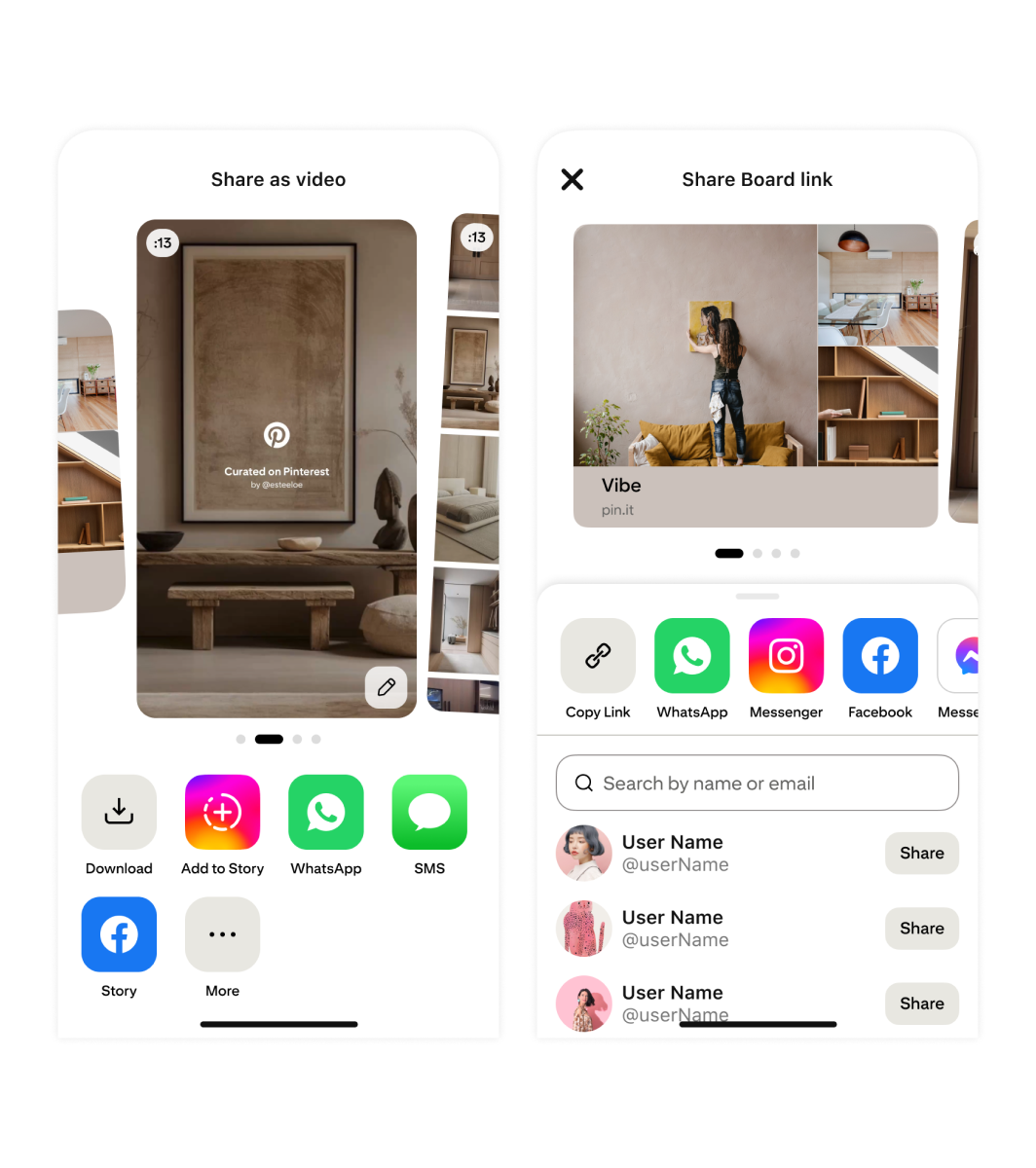
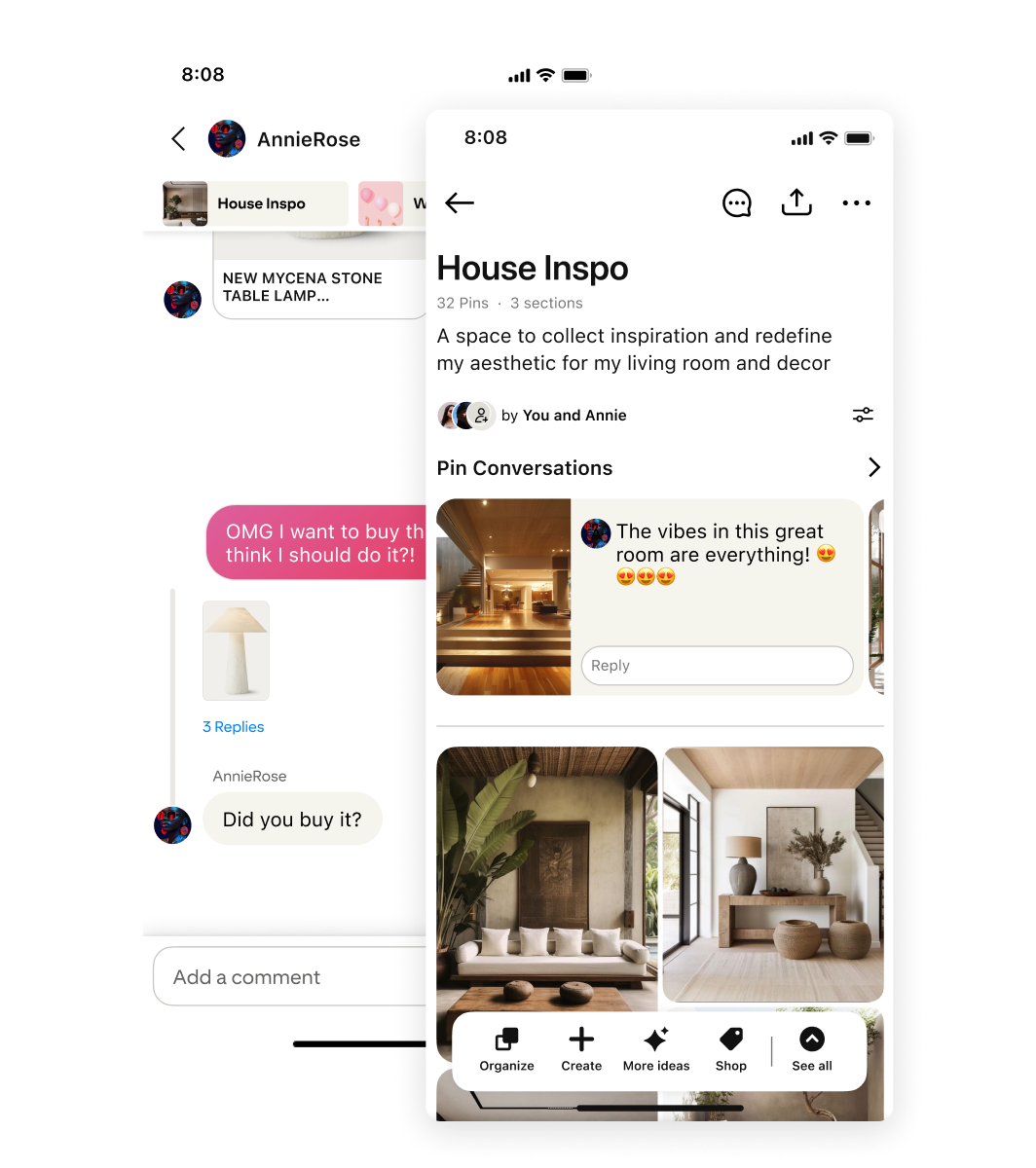
Streamlined messaging
We gave the messenger a new identity, starting with threading, then easy access to boards so Pinners can move seamlessly in and out of the places where they collaborate.
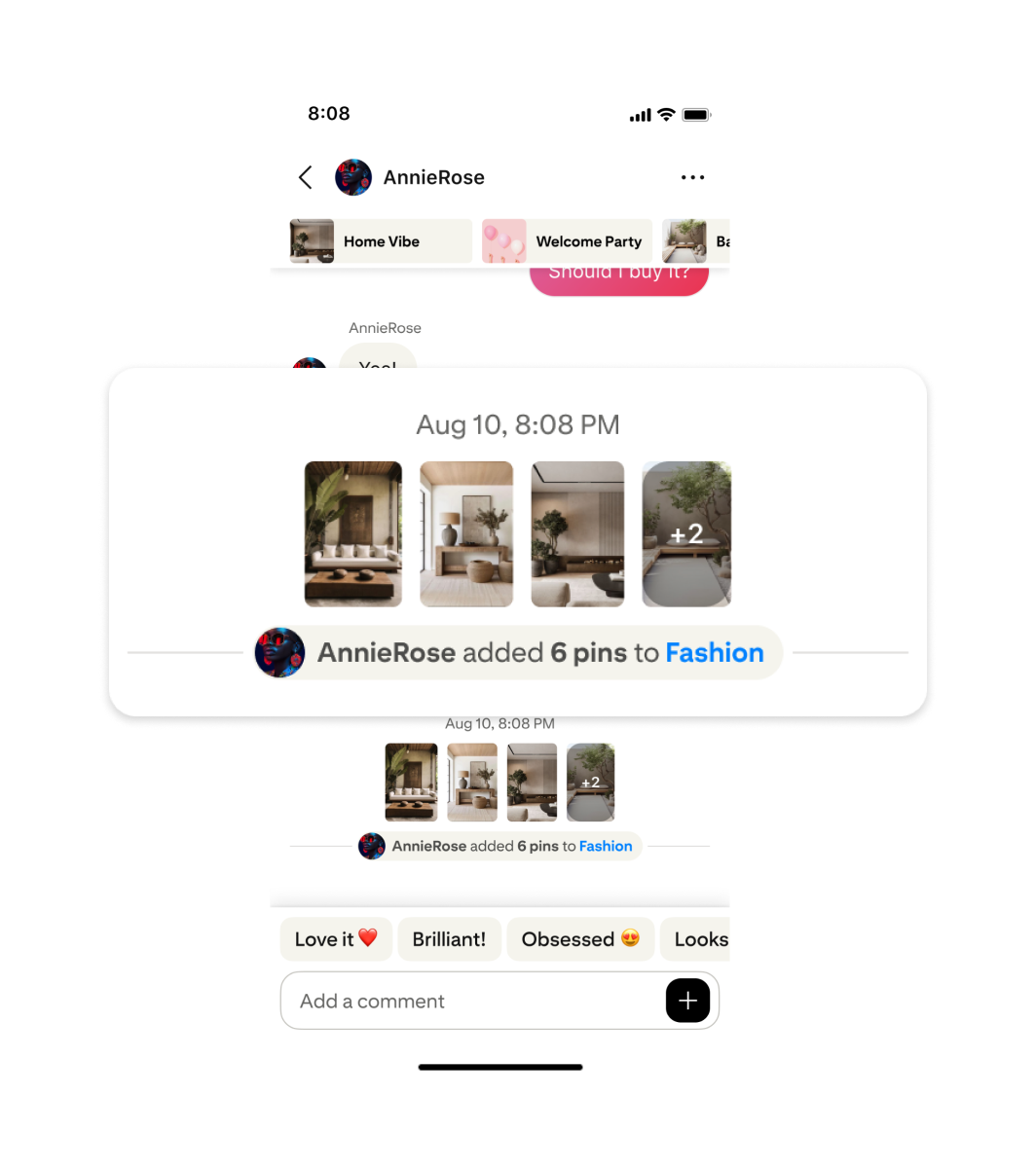
Improved system messages
New system messages summarize board activity, giving Pinners insight into what changed on a board and an easy way to dive in and see the updates.
Better feedback loops
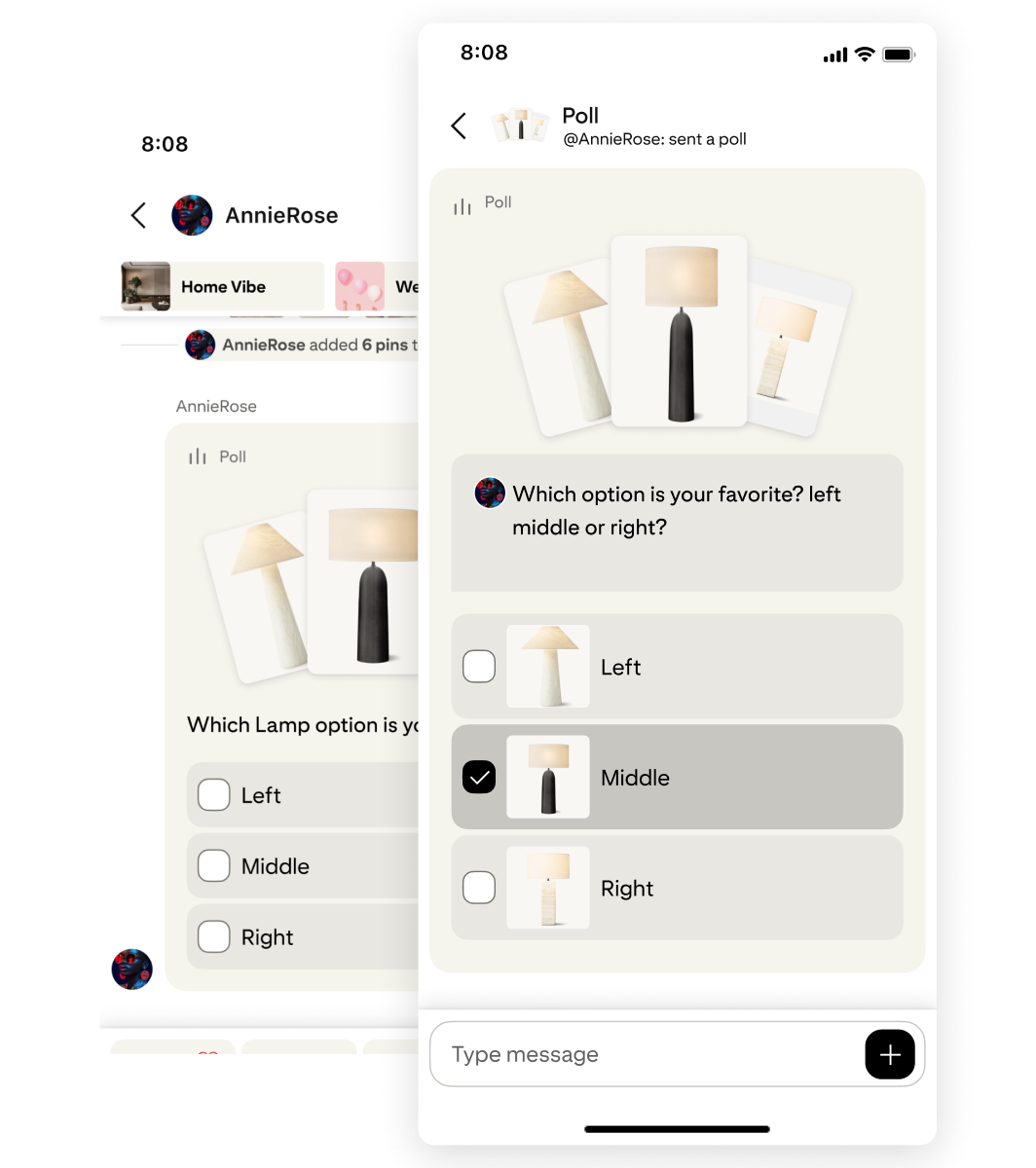
Polls in messages and boards let groups gather specific feedback on the options they are deciding between. It helps Pinners make progress in the refinement stage and shows where they are on their journey.
Signed-out to signed-in experiences
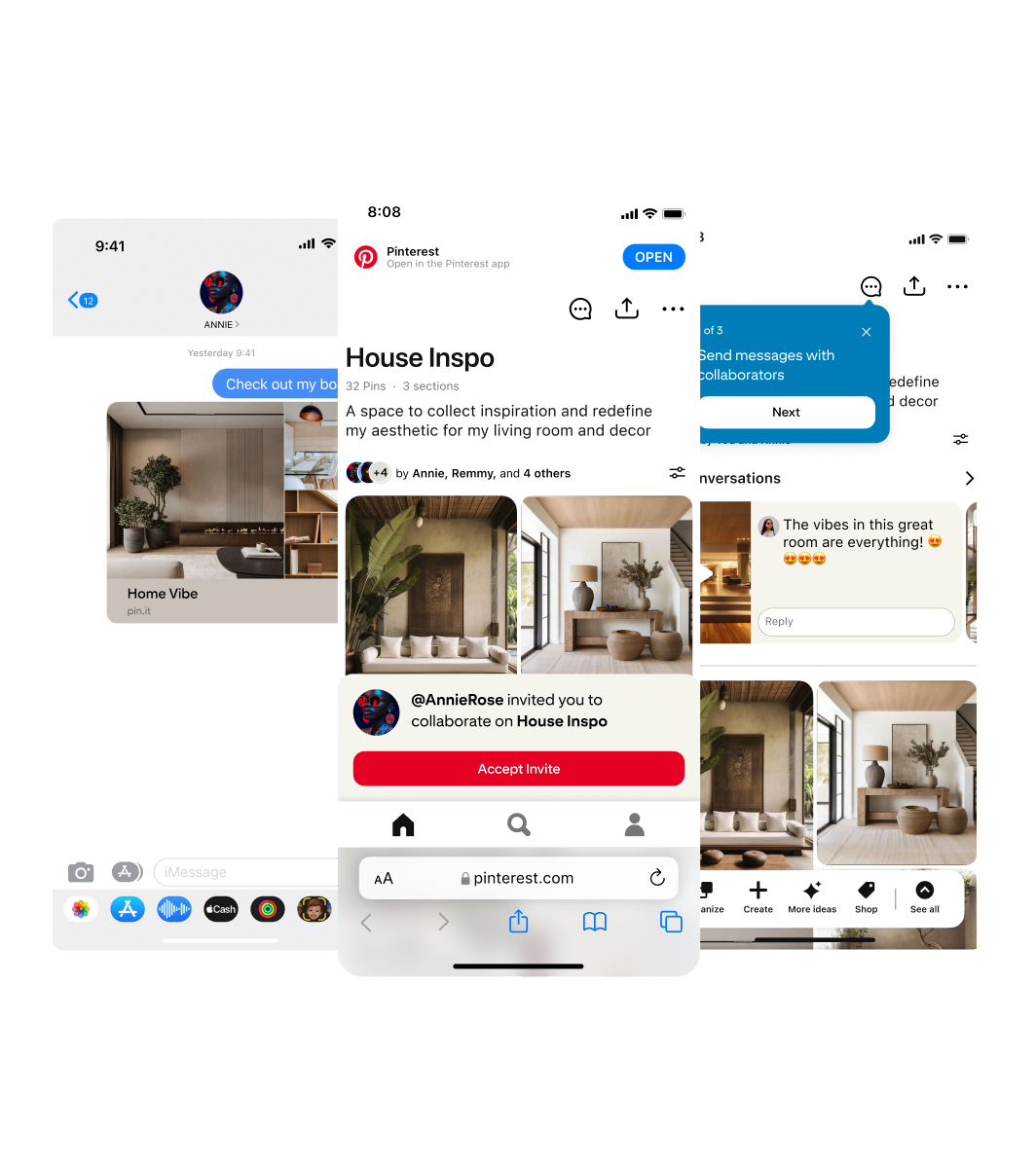
Contextual landing experiences let signed-out receivers explore naturally without walls, with contextual onboarding that turns an invitation into a collaborator.
Impact
The system moved behavior, not just pixels.
The redesigned vertical Share Sheet drove +25% internal shares and +970K weekly message senders. Gen Z commenting ran 3x higher than older Pinners, and Group Board users had 14% more engaged sessions than non-users. Design choices on one surface changed social behavior across the whole ecosystem.
Source · Pinterest experiment readouts, 2023–2024
What it unlocked
The leverage is in the next ten features that didn't need to redesign the share sheet.
The work compounded in three directions at once.
For users
Easier sharing. More contextual collaboration. Better feedback loops. Clearer updates.
For the business
Stronger internal sharing. Better support for social growth. More retention-oriented loops.
For teams
Shared platform language. Reusable design system patterns. Clearer path for future formats.
Senior tradeoffs
What it cost.
Every platform decision traded something real away.
- ✦Native familiarity vs. product control: native was faster, but weakened Pinterest-specific social loops
- ✦Consistency vs. flexibility: teams needed configuration without fragmenting the UX
- ✦Connection vs. pressure: Pinterest had to remain safe, personal, and low-pressure
- ✦Vision vs. sequencing: the ecosystem was broad, so we identified foundational bets first
Reflection
“The biggest learning: platform work only earns investment when it's tied to a clear user and business narrative. Strategy and systems have to reinforce each other. The connection strategy justified the platform, and the platform made the strategy real.”
Next case study · Coming soon